



Holding…
This Sundays quotation is from the Buddha.

Anger is always portrayed as the bad guy, isn’t it. Of itself, anger is a healthy emotion. It allows us expression in the face of a perceived threat. The problems arise when, instead of expressing the emotions in an acceptable way, we allow them to fester within us like an unhealed wound. The sad thing is that, as the Buddha says, we hurt ourselves by bringing dis-ease to our bodies.
Just for Today!
What are you doing NOW this minute? What does it feel like? Are there any particular smells or tastes peculiar to what you are doing? This is what the first line of Mikao Usui’s five Precepts is all about – being mindful or aware.
Most of us travel through life on automatic pilot, blissfully unaware of our surroundings or the details of our actions. When was the last time you felt the bubbles as you washed dishes, or smelt the unmistakeable smell of a clean metal saucepan (we call it the ‘fresh metal smell’ in our house)? Did you stop the car to admire that sunset? Did you even notice it – or were you too busy talking to your friend beside you?
Take a moment right now to stop and look around you – I mean really look. Now listen. Now smell. Take a deep breath and allow yourself to be aware of all the things you have just noticed using your senses. Breathe deeply for a few more moments just being aware, noticing any changes.
This is called being mindful. You don’t actually need to stop what you are doing to be mindful, but you do need to focus exclusively on whatever it is you are doing at any given moment in time.
This book The Miracle Of Mindfulness: The Classic Guide to Meditation by the World’s Most Revered Master (Classic Edition)
5 Precepts
Mikao Usui gave his students 5 Precepts to follow which were his adaptation of an earlier set of precepts dating back to the 9th century. The full wording of these precepts is
The secret art of inviting happiness
The miraculous medicine of all diseases
Just for today,
Do not anger,
Do not worry
Be Humble
Be honest (in your dealings with other people)
Be compassionate towards yourself and others
In every morning and evening join your hands in prayer,
pray these words to your heart and chant these words with your mouth:
“Usui Reiki Treatment (for) Improvement of body and mind”
The Founder, Usui Mikao
These precepts were chanted daily by his students and were said to promote an equal amount of spiritual development as all the energy work they did.
Understand…
Every Sunday I will be sharing with you a quotation that I come across during the week. This week’s quotation is from Mikao Usui.
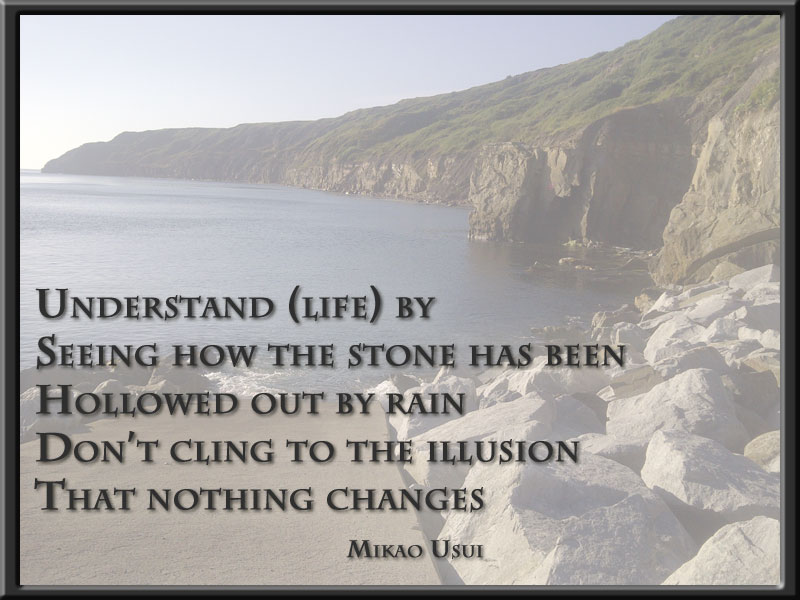
It’s so easy to get into a certain way of doing things or thinking about things, we all do it especially as we get older. When changes happen we start feeling angry and resentful because our routine or way of thinking has to alter. We direct that anger at whoever we perceive to be the instigator of the change. We would save ourselves and others a lot of dis-ease if we could see change as something positive, a challenge to help us grow.
Reiki in Japan
Most of Mikao Usui’s students started out as his patients. As part of the treatment he would give them empowerments so that they were permanently connected to the energy source and could treat themselves until their next appointment with him.
His first manual contained the Precepts, Meditations and Waka poetry. His teachings were given one to one and were varied to each student’s need. The teachings comprised three levels: Life teachings, Mystery teachings, and Deep mystery teachings and focused on meditation, chanting sacred sounds and self-treatment.
In 1923 Usui was approached by the Japanese military and asked to teach them a simple hands-on healing system to supplement their shortage of medically trained officers. This changed the focus of his system from healing self to healing others. Usui together with one of his advanced students, Eguchi, devised the symbols we use today as a quick way for the officers to learn to use the energies, allowing them to achieve in a short space of time what had taken his former students months of meditation and chanting.
Mikao Usui
Mikao Usui, the founder of Reiki, was born in Japan on 15th August 1865. He entered a Tendai Buddhist monastery as a child and from the age of twelve trained in the art of Samurai swordsmanship.
He married and had two children and followed a number of professions including that of private secretary to Shimpei Goto. He travelled widely and studied extensively including traditional Chinese medicine, numerology, astrology, psychic and clairvoyant development, and Zen Buddhism.
The name Reiki was not used until after Usui’s death in 1926. He referred to his system as a “Method to achieve Personal Perfection” and his students referred to it as “Usui Do” or “Usui Teate” (Usui hand-application).
What is Reiki?
What is Reiki?
Reiki was originally taught by its founder, Mikao Usui, in Japan during the 1920’s as a spiritual path for those seeking enlightenment, and as a method of self-healing.
Today in the West, Reiki is primarily thought of as a form of complimentary medicine or spiritual healing.